
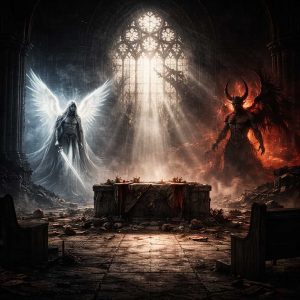
 Diablo II is remembered for its dark tone, punishing difficulty, and obsessive loot chase. But beneath the clicks and carnage sits a clear thematic core. The game is built on religious symbolism, and even Diablo 2 gear can feel like sacred artifacts or cursed icons pulled from that struggle. Angels and demons are not background flavor. They shape the story, the world, and the player’s role in it. Diablo II uses familiar religious ideas, then bends them into something colder and more tragic.
Angels without mercy
At first glance, the angels of Diablo II seem drawn from Christian tradition. They serve the High Heavens, fight demons, and frame the conflict as an eternal war between order and chaos. But the game quickly complicates that image.
The most prominent angel is Tyrael. He appears as a guide, yet rigid laws bind him. He cannot openly intervene, even when humanity is on the brink of destruction. This echoes a common religious tension: divine authority constrained by its own rules. Heaven is powerful, but distant.
Other angels push this idea further. Figures like Inarius show that angels are capable of pride, fear, and betrayal. They are not purely benevolent beings. Their concern is order, not compassion. Humanity matters only as a variable in a larger cosmic balance.
This portrayal mirrors older religious texts, in which angels are messengers or enforcers rather than moral teachers. They do not exist to comfort humans. They exist to serve a system. Diablo II leans into that discomfort. Heaven feels sterile and authoritarian, not warm or redemptive.
Demons as corruption, not chaos
If angels represent rigid order, demons represent corruption rather than simple evil. Diablo II’s Prime Evils are not wild forces. They are planners, manipulators, and corrupters of faith. Diablo embodies fear itself. His power lies in breaking the mind before destroying the body. Mephisto rules through division, turning families, churches, and nations against themselves. Baal is not mindless. His destruction is methodical, aimed at erasing hope and rebuilding the world in ruin.
This aligns closely with religious symbolism, where evil spreads through temptation, resentment, and despair. Demons in Diablo II rarely force humanity into sin. They invite it. Corruption feels voluntary, which makes it more disturbing. The setting reinforces this idea. Churches are desecrated. Sacred relics are twisted into weapons. Faith is not erased. It is hollowed out and repurposed. Evil succeeds not by denying belief, but by poisoning it.
Humanity is caught in the middle.
What makes Diablo II’s religious symbolism work is its treatment of humanity. Humans are not chosen heroes or fallen failures. They are survivors trapped between two uncaring extremes.
Unlike traditional religious stories, salvation does not come from heaven. Angels refuse to act. Demons exploit that absence. The player steps into this gap, not as a divine champion, but as a mortal with limited power and no guarantees.
This reflects a bleak theological idea. If gods exist, they may not save you. Moral responsibility falls on flawed individuals who act despite their flaws. The player’s victories feel temporary. Every demon slain is a delay, not a solution.
Even the game’s ending reinforces this tone. Evil is sealed away, not destroyed. The world is safe for now, but the cycle continues. Eternal conflict is not a metaphor. It is a condition of existence.
Sacred imagery and broken rituals
Diablo II’s visual language leans heavily on religious imagery. Cathedrals, catacombs, altars, and icons fill the world. Yet they are almost always damaged or defiled. Rituals fail. Priests are corrupted. Holy places become battlegrounds. This constant collapse of the sacred suggests a world where faith has lost its protective power. Belief still exists, but it no longer shields humanity from suffering.
This is not an attack on religion. It is a meditation on what faith looks like in a broken world. Diablo II treats belief as fragile. It can inspire resistance, but it can also be manipulated or shattered.
The eternal conflict as tragedy
The phrase “eternal conflict” sounds epic, but Diablo II presents it as tragic. Neither side truly wins. Heaven maintains order at the cost of empathy. Hell spreads suffering without end. Humanity is left to absorb the consequences.
This framing feels closer to medieval religious thought than modern fantasy. Good and evil are real, but the world remains harsh and unjust. Survival requires endurance, not purity. That is why Diablo II’s story still resonates. Its religious symbolism is not about answers. It is about tension. Between faith and doubt. Order and freedom. Power and responsibility.
In the end, Diablo II does not ask the player to believe in angels or demons. It asks a more complicated question. What do you do when salvation is uncertain, and the war never truly ends?